
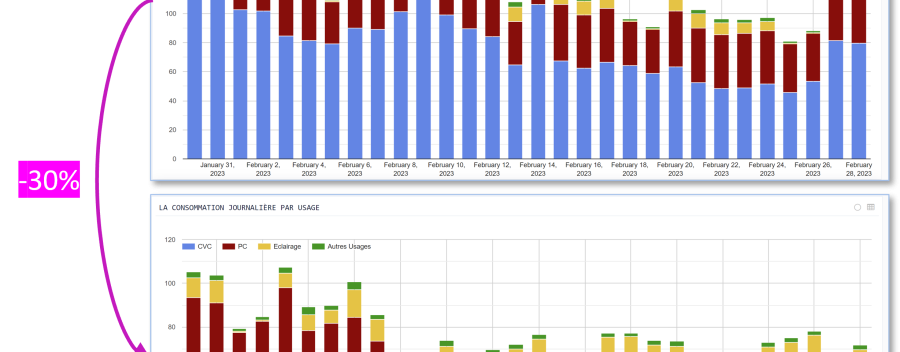
Many studies have shown that simply measuring and monitoring your energy consumption can reduce it by 10% to 20% — provided that you take action based on what you observe.
Let’s take a real-world example:
a 460 m² office building accommodating up to 30 employees.
Step 1 — Understanding the Consumption Profile
An energy sub-metering system was installed to go beyond the building’s total electricity use.
It provided detailed insights into four main categories:
- Ventilation (heating/cooling)
- Lighting
- Sockets and equipment
- Other consumption sources
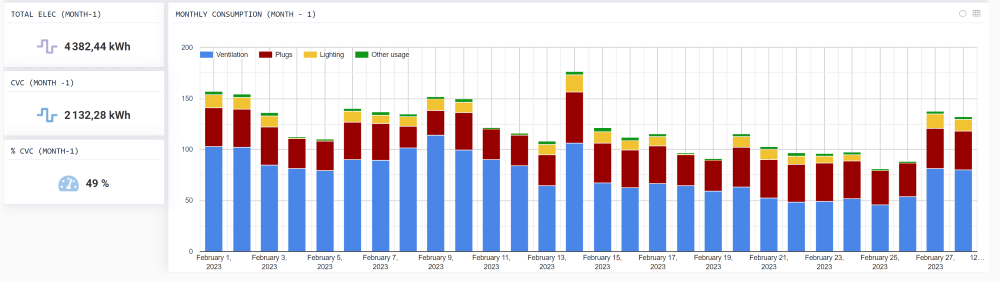
In February 2023, total electricity consumption reached 4,382 kWh.
A detailed breakdown revealed that ventilation and air conditioning accounted for 49% of the total.
Interestingly, this consumption remained almost constant between weekdays and weekends, even though the building was unoccupied during weekends.
👉 First conclusion: optimizing the ventilation system’s operation schedule could have the most immediate and significant impact on energy savings.
Step 2 — Focusing on Daily Patterns
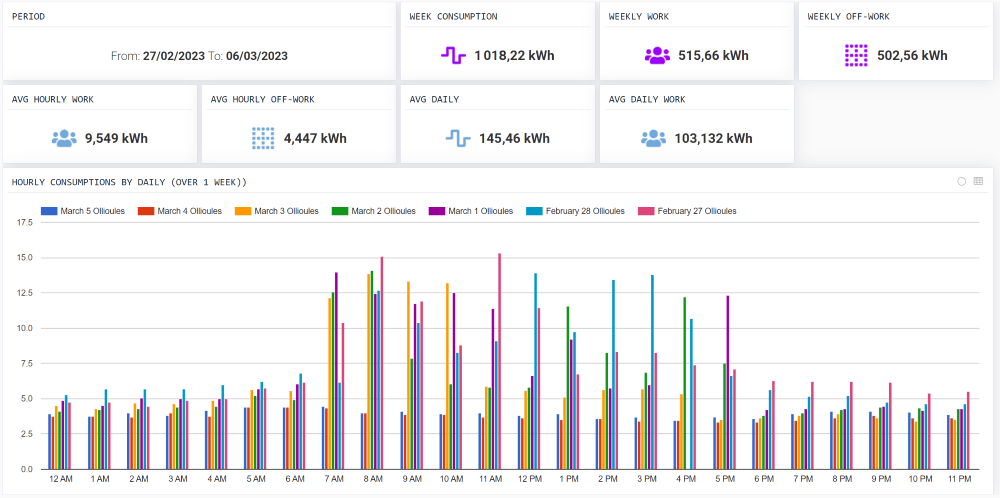
When we zoom in on daily consumption for the week of February 27, 2023, the data confirmed this observation:
- Working hours: 516 kWh/week
- Non-working hours (evenings + weekends): 503 kWh/week
That means almost half (49.5%) of the total weekly consumption occurred outside normal operating hours — when no one was in the building.
Step 3 — Taking Action
A simple timer switch (€50 investment) was installed on March 10, 2023, to turn ventilation off outside working hours.
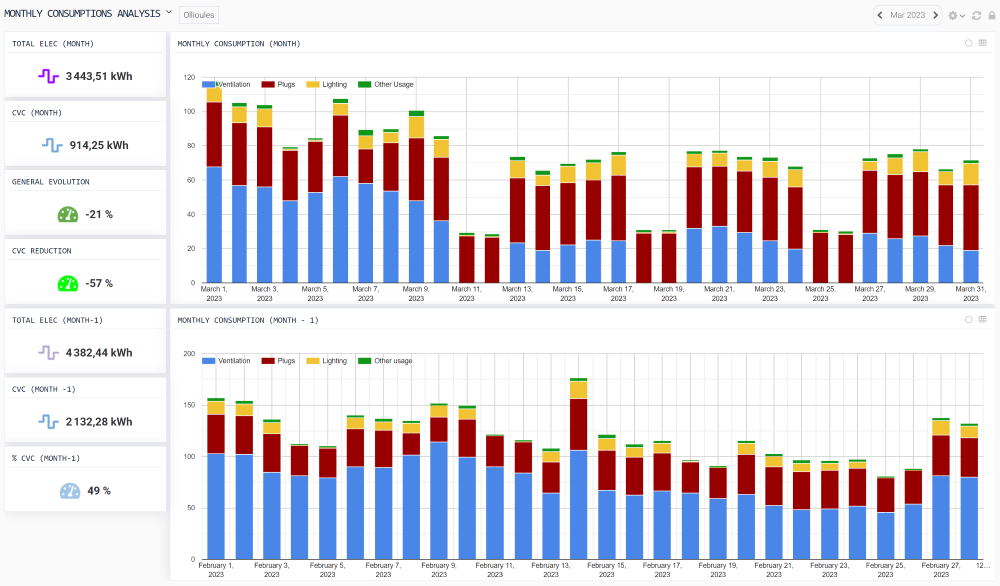
The effect was immediate and visible from March 11, 2023.
When comparing March 2023 to February 2023:
- Weekend consumption for ventilation dropped to nearly zero
- Weekday consumption also decreased noticeably
- Despite being implemented mid-month, the change already led to a 21% reduction in total electricity use
Step 4 — Measuring the Impact
When comparing hourly data:
- Before action (week of Feb 27): 1,018 kWh
- After action (week of Mar 27): 627 kWh
That’s a 38% reduction in total electricity consumption!
With an average energy cost between €0.20 and €0.40 per kWh, this translates to monthly savings of €333 to €666 — just by optimizing a timer.
Additionally, the share of energy used during working hours increased from 50% to 63%, reflecting a much more efficient usage profile.
Step 5 — Lessons Learned
This case perfectly illustrates a simple truth:
You can’t improve what you don’t measure.
By continuously monitoring energy consumption, businesses can:
- Understand their usage patterns
- Identify inefficiencies
- Implement corrective actions
- Measure the results
- Repeat the process
Energy efficiency is not a one-off project — it’s an iterative journey.
And the good news? Significant results are often achievable without major investment.
How we help?
- Configurable dashboards to visualize and analyze consumption
- Automated reporting for transparency and follow-up
- Decision support tools to identify optimization opportunities
- Expert guidance to help you define and implement concrete actions
Learn more about Energy Efficiency ?